
Why More Landfills Are Making the Switch
Active landfills in the United States are legally required to cover exposed waste at the end of the working day.
A longstanding method is hauling in truckloads of soil to spread six inches deep across the working face. This slow expensive process ate into airspace, which of course is a precious resource for landfill operators.
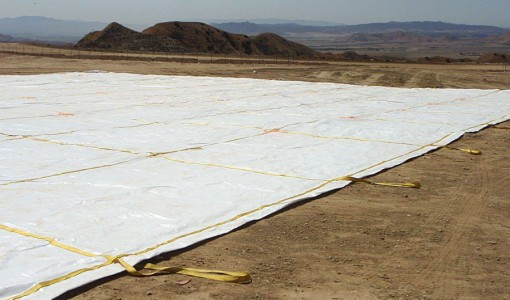
Landfill operators are increasingly turning to alternative daily covers (ADCs). These engineered geosynthetic tarps and specialized materials meet regulatory requirements while improving operational efficiency. If you manage a municipal solid waste (MSW) landfill or evaluate a facility's daily cover strategy, read on for an overview of ADCs.
What Is an Alternative Daily Cover?
An alternative daily cover is a material other than soil used to cover a landfill's active working face at the close of each business day.
ADCs control odors, prevent fires, reduce windblown litter, and minimize vectors (animals and pests that spread disease). This helps meet federal and local regulations concerning community and environmental impact of landfills.
Limits of Traditional Soil Cover
Airspace loss from spreading six inches of compacted soil across a large working face adds up fast. Since the soil is not waste it generates no revenue yet occupies the space that paying waste would otherwise fill.
Beyond airspace, soil cover requires dedicated equipment, fuel, labor, and a reliable source of clean fill material nearby. If suitable soil is scarce or must be hauled from off-site, costs rise. Excavating, hauling, spreading, and grading soil, are time-intensive and hard on equipment.
Methane gas-to-energy programs at landfills can have issues from compacted soil impeding migration of landfill gas to collection points, reducing energy-recovery potential.
What Type of Alternative Daily Cover Should I Get?
For most large-scale MSW operations, reusable geosynthetic landfill covers offer regulatory compliance, operational efficiency, odor control, and long-term cost savings.
Widely used covers are typically reinforced polyethylene or polypropylene.
These are deployed over the working face at the end of each day using dozers, excavators, or automated tarping machines.
Readily roll the cover back up the following morning before operations resume. Daily removal means these add no permanent volume to the landfill mass and do not interfere with gas or leachate-collection systems.
High-quality geosynthetic tarps can last many deployment cycles, with service lives ranging from two years to ten years depending on climate.
Debrovy's Alternative Daily Covers: Built for the Working Face
Our high-quality geosynthetic ADCs meet the demanding conditions of active landfill environments by offering superior durability, UV resistance, and performance under repeated deployment cycles.
Our three cover types are listed below:
- Polyethylene Closed Cell Landfill Covers: These effectively block odors and prevent precipitation infiltration. Closed-cell construction adds structural rigidity while remaining flexible enough for easy handling and rapid deployment.
- Solid Polyethylene Landfill Covers: Available in multiple thicknesses to match a site's specific exposure conditions. Lighter 12-mil options deliver two to two-and-a-half years of service (or up to five years in lower-UV climates), while 24-mil covers extend service life to eight to ten years or longer in favorable conditions. Solid polyethylene ADCs offer a clean, reliable barrier against wind, pests, and precipitation.
- Polypropylene Landfill Covers — Mesh offer a breathable alternative where some airflow through the cover is acceptable or desirable. The mesh construction reduces wind uplift and is particularly well-suited to sites with variable wind conditions.
Our covers’ lifespans are determined by thickness:
- 12 mil gets 2 or 2.5 years (up to 5 years with less sun exposure)
- 14 mil gets 4 years (can be up to 7 years in a cooler climate)
- 20 mil gets 6 years (this can reach 10 years in cooler climates)
- 24 mil gets 8 to 10 years (15 years is possible in a cooler climate)
All Debrovy's landfill covers are available in a wide range of standard sizes. On the low end are compact 40' × 40' covers for smaller operations. Large-format 150' × 150' covers are available for high-volume MSW facilities.
Custom sizing for ADCs is available on request.
Key Benefits of Switching to an ADC
- Airspace Preservation: Consistent ADC use can extend a landfill's operational life because less airspace is taken up than in soil applications.
- Cost Savings: Deploying geosynthetic ADCs generally requires less labor, less fuel, and less equipment wear than excavating and hauling soil.
- Regulatory Compliance: ADCs approved by the EPA and state's enforcement agency satisfy federal daily cover requirements. Reach out to Debrovy's to find ADCs that meet your regulatory requirements.
- Odor and Vector Control: Well-deployed geosynthetic ADCs effectively contain odors and prevent animals from accessing waste, thereby mitigating the spread of diseases. This fosters a positive relationship with surrounding communities and reduces the risk of regulatory complaints.
- Gas and Leachate Management: Reusable geosynthetic are removed each morning before new waste is deposited. These do not permanently seal or compress waste layers, allowing landfill gas and leachate to flow freely to collection infrastructure. That supports methane capture and energy-recovery programs.
How to Choose the Right Alternative Daily Cover for Your Landfill
Consider the following:
- The size of your active working face
- Daily tonnage
- Availability of deployment equipment
- Local wind and weather conditions
- Specific regulatory requirements of the state
Consider material thickness based on landfill climate. High-UV regions demand a heavier-mil cover for longer service life and better long-term value.
In cooler or cloudier climates, lighter materials may be adequate for years beyond the nominal rating.
Facilities operating a gas-to-energy program should prioritize reusable covers to preserve free gas migration and maximize energy recovery.
Reach out to Debrovy’s to get our expert advice on what ADC would work best for your situation!